Thursday, January 28, 2010

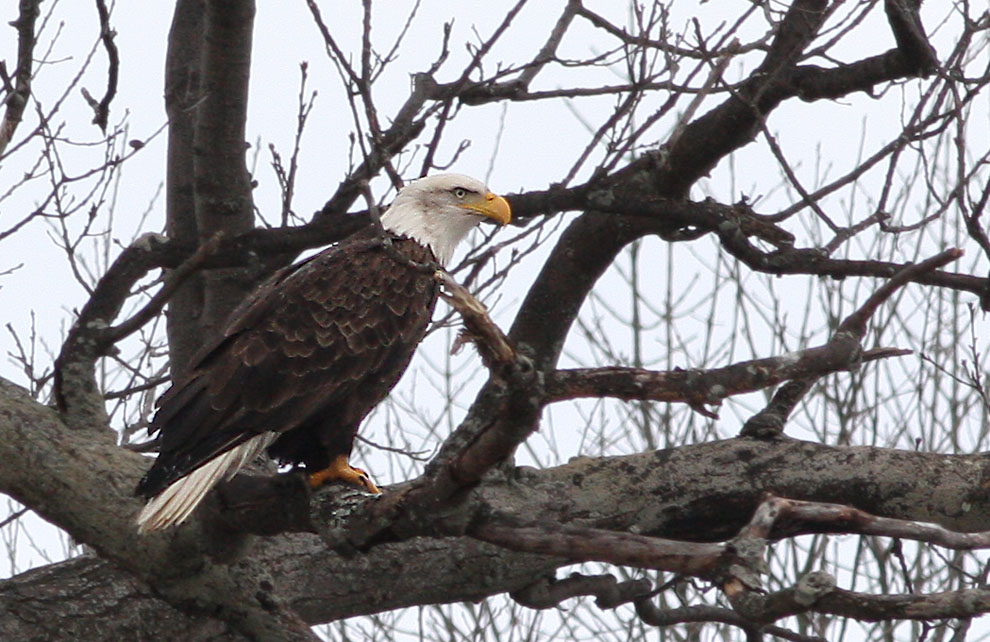
Ft Cassin Bald Eagles, Vergennes Vt

A friend and I visited Ft Cassin in Vergennes Vermont yesterday looking for eagles.

We found 14 eagles spread all around the area. The most interesting part was finding 5 juveniles and one adult on the ice south of the river outlet fighting over a fish. One juvenile managed to hold off the others with lots of wing flapping displays.

But after about ten minutes of defending its fish the larger adult (female probable) moved in and took the prize uncontested. It was also a good day for hawks, here is the only image I got of the light morph Rough-legged Hawk that I found in a field south of Richville rd and rt 22a Shoreham VT. I think that it is a adult male but would love some input from others about this beautiful Rough-legged Hawk. here is what we found yesterday from ft Cassin Vergennes down Rt 22a to Rt 4 Fair Haven Vermont.

Bald Eagles 14 6 adult 8 juv
Red-tailed Hawk 13
Rough-legged Hawk 4
Kestrel 3
Northern Harrier 1
Pileated Woodpecker 1
Eastern Bluebird 5
Good Birding to all!
Peter Manship
Story and Images © 2010 Peter Manship LLC

Monday, January 18, 2010

Winter Hawk and Eagle watch 1-16-10


This post is a mix of the last two days birding in the Champlain Valley with the Rutland Audubon and yesterday with Bill Jalbert. Here is the image of the Eastern Red-tailed Hawk with the eastern Canada type feature - dark throat instead of a white patch or striped.

Note the dark throat which is typical of northern Canada RT's - see page 56 , plate RT02 of Hawks from Every Angle by Jerry Liguori for a brief description. BTW a very helpful book to have. Compare with Sibley's Redtail images.
Bill captured this beautiful Bluebird image at one of the many stops the group made. I got zip for Bluebird photos even though we were standing 2 feet apart. Bluebirds seem to be somewhat of a problem for me; can you say nemesis! At Ft Cassin the group located 6 Bald Eagles, 3 adults and 3 juveniles. Two were bathing in the frigid water on the shore, a scope's view away. Eventually one flew in our direction and landed nearby where we were able to get some nice images of it. Here are some images I took of the bathing juvenile eagles; this very wet one is sunning it self dry - drying out his or her feathers, I think that this juvenile eagle could be a 3rd year bird. Can anyone clear that question up. finally, taking flight! See header above also.This is where we got separated from the Audubon group. With a dead radio and not capable of communicating with the Audubon group anymore, we just birded our way south along the lake. One of the highlights was finding a Peregrine Falcon almost where we had found one last winter on Lake Street in Bridport. The image bellow is a Cooper's Hawk not a peregrine.Sunday would prove to be an amazing birding day. We covered south of Rt 125 Bridport. This is a beautiful Copper's Hawk image that Bill made.

We were upwind of this Ruffy and if flew right at us. What luck!
Probably the most amazing part of the day was the tally of 17 Red-tailed Hawks, 1 peregrine, 2 Cooper's Hawks, 2 Rough-legged Hawks and ending the day with a Barred Owl. Bill Jalbert's owl image .
For a list of what we saw Sunday
check here:Vermont E-bird NOTE This list is not totally correct. The peregrine count is 1 and the Cooper's Hawk count should be 2 and one Sharp shinned Hawk. Thanks Roy.

If you're wondering why so many are Bill Jalbert's images and not mine, my camera was acting up all day long and more importantly, Bill's images are great too! So what's the difference?
As for me I can't wait to go looking for more wintering hawks south of Rt 73 next time.

Good Birding to all,
Peter Manship

photos by Bill Jalbert where noted all others by Peter Manship

© 2010 Peter Manship LLC

Wednesday, January 13, 2010

Sage Thrasher, Salisbury Beach Mass. 1-12-10


Yesterday I ran down to Salisbury Beach SP in Mass to try and locate the Sage Thrasher that was reported on Mass-ebird the day before. I left Vermont at O-Dark-Thirty (4:45) so I would be down there early, hoping that when I pulled in some of the NH birders that I bird with would have already found the thrasher. There was 25 or so people walking around looking. It didn't look good. I asked the first person that I came to if they had seen the bird and they said that it was seen earlier but..... I parked the car and joined the search. I soon found one of the NH birders. I asked Jason if I could join him looking for the bird and the whereabouts of other NH birders. He said they are all looking for the Ivory Gull.

We looked everywhere and after about thirty minutes I noticed something moving under a bush . I looked through my binoculars. “I've got It!”Jason signaled the others and "texted" the other NH birders who were combing the seacoast for an Ivory Gull, which was never found. It was amazing! Ten minutes later it was like old home week; people started pouring in to see the Sage Thrasher.

Also at Salisbury were these Horned Larks that were sandbathing. What a sight.

This Horned Lark made a small bowl in the sand by flipping its wings. You can see sand flying in the next image.All in all I had a great time seeing everyone again and spending the rest of the afternoon birding the NH seacoast. Interestingly, they were all looking for high point value birds for the Superbowl of Birding VII. What I didn’t know was that the group represented two teams; everyone was acting cool asking each other questions about where they were going or where they had been birding and the answers were all bold face lies. They were all sandbagging, telling each other lies to misdirect the other team. It was fun to hear and watch the friendly banter.

Here is a list of birds seen by me today:

Sage Thrasher 1
Merlin 3
Kestrel 1
Snow Buntings 15
Horned Larks 12
Tree Sparrow 9
Savannah Sparrow 1
Glaucous Gull 1
Herring Gull many
Ringbilled Gull many
Greater black-backed Gull 7
European Starling 2
Common Eider 8
Lesser Scaup 5
Mallard 2

Good Birding

Peter

Story and images© 2010 Peter Manship Designs LLC

Saturday, November 7, 2009

River of Black Birds, Portsmouth, N.H. 11-6-09

5oo,ooo Blackbirds! That is my guess as to how many blackbirds there were and that is really a moot point because the experience of seeing that large a number of birds flying by is somewhat overwhelming. Everywhere you looked, it was blackbirds! This image was facing northwest-ish. It started out slowly, but that changed very quickly. There were three streams of birds - one north and south of our location and one overhead. That's not to say there weren't others; there were. They were scope range at best and more importantly, largely overlooked because of the distance to them. Plus there was an extraordinary number of blackbirds flying by at close range. The stream to the southeast was very large and dense, but you had to look through a scope to see it. Case in point. The image below shows birds passing in front of the moon . Not too far away, but in the lower left hand corner is a distant and larger group of blackbirds passing by that went unnoticed by me until I got home and was looking at the images on the computer. Image below is a 200% enlargement of the marked area from the image above.

This is an example of what it was like. It points out how hard it would be to try and get an accurate count of the total number of blackbirds flying in to the Great Bog roost area in Portsmouth NH.

Here is an image of the group watching the blackbirds flying overhead.

The dark pink area on the horizon in the center of the above image looked like this image below through my 400mm lens.
It was a life experience that is very difficult for me to put in words. Even the images don't convey the scope of the event. They do, however, offer fragments of a much larger picture. The image below is looking east and similar views were going on to the south and west when I recorded this image. The roost fly-in lasted about 45 minutes or so and the sound was impressive.What I would say, is that if this happens again next year, a trip down there to experience it first hand would be highly recommended. Who knows, maybe we could carpool next year!


I had a great time birding the coast of New Hampshire thanks to Steve and Jane Mirick, Len Medlock, Jason and all the others, and The River of Blackbirds is truly an unforgettable experience!


Thelma turned over 200,000! It happened at 4:20am about a mile west of Warner, NH.

Marv Elliott of the Rutland Audubon had the winning guess of Nov 4th. A special thanks to all 47 people that entered the Thelma Mileage Contest. Marv will be receiving a framed Red-tailed Hawk image from those taken at Mt Philo back in September. Again, thanks for taking the time to enter.


Peter Manship

images and story © 2009 Peter Manship All rights reserved

Wednesday, November 4, 2009

Birding the New Hampshire Seacoast 11-1-09

The alarm went off at 3am! I really didn't want to get up, but I knew I had to get moving. I made it to Rye Harbor, NH by 6:30 and started trying to locate the Common Murre which had been reported on the NHbird list the day before. With an hour to spare I was hopeful of sighting the murre, but it was gone. I had to get going if I was going to meet up with Steve Mirick and the others by 8am. I was doing fine until I got to the Seabrook Harbor Bridge which was down to one lane for repairs and the light was red. I sat there waiting for the light to change; then a boat passed through the bridge and it was 7:55 when I finally got across. Too late, I thought, so I decided to wait at the Seabrook harbor parking lot. There was a Black-bellied Plover hunting for food. Here's and image of the plover:As 8:30 rolled around I noticed that there weren't any birders here. They must be starting somewhere else. No biggie, I'll bird the coast and eventually our paths will cross.
Here is an image of a White-rumped Sandpiper from Ragged Neck on the NH seacoast.On the north side of Rye Harbor State Park there were quite a few shorebirds working the wrack line (washed up seaweed, etc.). I settled in photographing the shorebirds when I flushed a sparrow that looked different. Couldn't relocate so I was returning to photograph the shorebirds when it popped up just in front of me. After photographing it I asked Denny Abbott if he knew what it was. Looking at the image "Ipswich" type Savannah Sparrow was his response. A life bird for me! Here are some image of the Ipswick sparrow: and some shorebirds - Dunlin preening:
A molting juvenile Sanderling: juvenile Black-Bellied Plover:There was a flock of about 70 Snow Buntings feeding in the parking area. I left Denny and headed north. I was hopping to find Steve and the Brookline Bird Club. Driving south again having not found them, I noticed a car approaching with a person waving out the window; it was Denny. "What's up?"
"I found the Common Murre right after you left, about 10:30 in the harbor," he said. I raced back to the harbor excited at the prospect of finding this rare bird. As I walked up to the edge of the seawall, there was a woman scanning the harbor. "Did you find the murre?" I asked.
"Nope, been looking for 10 minutes with no luck."
" I was just told that the murre is here." We doubled our effort. Not much luck, I decided to move down the road and we agreed to get the other if we found it. Well, she pulled in to where I was all excited. " I got it! " was all she said.
Back at Rye Harbor S.P. looking through my scope at this wonderful rare bird, when I hear, "You're too good to bird with me anymore!"
I turned and it was Steve Mirick and company. "Got the murre" was all I said. Steve promptly got the group and everyone was able to get great looks at the Common Murre, a life bird for most, me included. Here is an image I got from a mile away. Well almost.Here is a link to images of the Murre taken by Len Medlock. These are amazing images at point blank range from a boat that Len and Jason ( both of whom are great photographers) asked for to get a ride out to the bird. Enjoy!
How about this? Len Medlock doing the newest birding craze, "Tailgate birding." Here we see Len scanning off shore for rarities. As the day was coming to an end, I asked Steve if we could head over to see "The River of Blackbirds." Image below left to right - me with Steve Mirick and Len Medlock
Here is what Steve Mirick reported to NH Birds list about the river of blackbirds;
"200,000. For those who stuck around to the bitter end, we finished the day at the Great Bog blackbird roost and witnessed "The River" of blackbirds from the parking lot of the Target Store along Rt. 33 at the Greenland/Portsmouth town line. Today it started later than yesterday....at about 4:15 PM (EST) and continued non-stop until very late when it finished somewhat abruptly almost exactly at 5:00 PM. About 25 minutes after sunset! I really don't know how many birds there are in "The River", but today's flight was significantly longer than last night's and lasted about 40-45 minutes. Based on input from others, I decided to up last nights estimate of 100,000 to 200,000 birds tonight. There may have been more than that and Len seemed to think closer to 400,000 birds.....who knows? "
More info and images from the "River of Blackbirds" in a separate post. Plus Thelma turned 200,000 contest results in next post.

My list for the day,Total species seen 55, Life birds in caps:
Semipalmated Plover, Sanderling , White-rumped Sandpiper, Dunlin, Black-bellied Plover, Bonaparte's Gull,"IPSWICH" SAVANNAH SPARROW, COMMON MURRE, Common Eider, Surf Scoter, White-winged Scoter, Common Merganser, Long-tailed Duck, Red-breasted Merganser, Red-throated Loon, Common Loon,Horned Grebe, Red-necked Grebe, NORTHERN GANNET, GREAT CORMORANT, Double-crested Cormorant, Canada Goose, Mute Swan, Wood Duck, , American Black Duck, Mallard, Great Blue Heron, Red-tailed Hawk, Peregrine Falcon, Ring-billed Gull, Herring Gull, Great Black-backed Gull, COMMON TERN, Rock Pigeon, Mourning Dove, Downy Woodpecker, Northern Flicker, Blue Jay, American Crow, Horned Lark, Snow Bunting, Pipit, Black-capped Chickadee, Golden-crowned Kinglet, Ruby-crowned Kinglet, American Robin, European Starling, Cedar Waxwing, American Tree Sparrow, Song Sparrow, Dark-eyed Junco, Northern Cardinal, Red-winged Blackbird, Brown-headed Cowbird, House Finch, House Sparrow, Common Grackles and other blackbirds - 250,000 to 500,000
Will post more about this later this week.

Good Birding
Peter Manship

© 2009 Peter A Manship All right reserved

Tuesday, November 3, 2009

Yellow Warbler in November

Here are two images of what I think is a female Yellow Warbler (see the PS below). I saw it at Brilyea Access road yesterday afternoon. I was about 300 feet in from RT 17 looking for ducks when I saw a yellow flash. I was only able to get these two images before the bird took off.

I welcome any input about the birds ID.

P.S. As it turns out this warbler is a male Yellow Warbler thanks to Walter Ellison for the ID help. click here to read Walter's email describing this bird on Vtbird.

Good Birding

Peter Manship

Wednesday, October 28, 2009

Snow Geese at Dead Creek or Thelma turns 200,000


Monday - the sun came out! Amazingly, this October has been quite rainy and between work and rain (two words that can produce funny emotional responses), I took the day off and went birding. Dead Creek was my destination where I wanted to end the day with the Snow Geese flying in against the setting sun. Hopefully! Wandering the back roads between Route 7 and Lake Champlain is one of my favorite ways to spend a sunny day birding. At McQuen Slang I found Rusty Blackbirds in the Maple-leaf Viburnum along with many robins. The big surprise was the 45 plus juvenile Cedar Waxwings hawking bugs from the tree tops. Next stop was Whitney Creek to try and locate the Orange-crowned Warbler that was reported on VTbird. There were White-throated Sparrows , Savannah Sparrows and more Cedar Waxwings, but no Orange-crowned Warbler. Butterflies were out sunbathing, taking advantage of the warm sunshine. A half dozen Clouded Sulphurs were showing their wear and tear this late into the season. An Eastern Comma Butterfly (winter form) was also enjoying the sun before hibernating in the leaf liter for the winter. They are one of the first butterflies to fly in the spring, often seen late April and early May. Farrell Access road to Dead Creek was very slow; however, there was a lone female Hooded Merganser feeding at the pool in the bend in the road. When I finally arrived at Brilyea Access with winds out of the northwest, it was also quiet. Highlights there were two Pie-billed Grebes, Green Winged Teal, American Black Ducks, Mallards and a feeding Great Blue Heron. I had just enough time to take this image.
There was one of those large farm “honey bucket” spreaders bearing down on my position; it was time to move. At the goose viewing area there was Lady Bugs all over the place, and the Moon. What can I say! The Snow Geese might be down in numbers, but it is still a thrill to see them fly. Here is a link to a report in the Addision County Independent about the decline in the numbers of Snow Geese at the Dead Creek WMA facility. With the geese well back from the viewing area, I used my 400mm lens to close the distance some. A low flying Northern Harrier spooked the geese and I was able to make this image. I thought that there were about 2500 Snow Geese in the area for the afternoon. They only flew one more time towards the end of the day as the light was fading and most of the geese were in the southeast field anyhow; not a good place for sunset images. I looked back one more time just as I was leaving. Wow! I jumped out of Thelma, the jeep, (the official vehicle for all BFO adventures) and was able to record the header image. On the road as I approached the top of the hill on Route 17 and 22a, I saw the sunset reflected in the rear windows of the Addison town office building. A different way of showing it was a nice sunset.

On the way home Thelma, the Jeep, turned over to 199,000 thousand miles - which leads me to this. Guess the date that Thelma the Jeep goes over 200,000 and win a beautiful framed BFO's bird image for your effort. Person or persons closest to the date and time wins. All you have to do is email me with your Date and Time guess. Here’s a clue. I’m sure that this will happen in the next two to three weeks at the latest.

Use this address to enter : petermanshipdesigns AT gmail dot com

Good Luck!!!

Peter Manship


©2009 Peter Manship all rights reserved